
Catching up with some friends about how they are handling working from home, I realized that we would have been the ones working on handling this pandemic for our old company. What are we going to do if the state (Texas) decides to shut down all non-essential businesses? What’s our plan? Obviously, we would have had these discussions much sooner than today, but it does highlight a problem many small businesses face: What is your emergency preparedness plan?
Why you need one before anything is near?
During my 25 years in Austin, it has weathered two major flooding events. The businesses that had lived through the first one, for the most part, survived the second one much better. One of my favorite books is by Jim Collins who in Great By Choice outlined how a company must be ready for a disaster even if you don’t know what that disaster might look like. A plan is what is needed. The military makes plans for battles they know they will not follow to the letter, but having a plan, and a goal, gets you more success than just running out there and trying whatever.
Are you ready(.gov)
The thing is every business should have a plan for what to do in the event of a natural disaster or, as crazy as it sounds, a pandemic. Luckily for most of these situations, the government can help. Over at Ready.gov, they have resources for both personal and business preparations. Ready Business has toolkits for hurricanes, flooding, power outages, etc. They even have videos to help. The toolkits have questions you can answer about your company’s preparedness, which gives you areas to work on. For example, on the Power Outage Toolkit they ask the simple question: If the power outage affects the phone, internet, or cable,
can your organization operate without any of them?
With many of us now using Cloud-based software, this is a problem. At my previous company, every computer had a UPS (universal power supply) which is a battery backup so the computer can run for a brief time if the power goes out. It allows you to finish up transactions and safely shut down the computer. Every essential piece of electrical equipment was hooked up to one so that the store could keep running for a brief time when the power went out. We also had emergency lights that would go on if the power died.
Ready.gov also helps you create a plan. Two important questions in the planning section I believe applies to our current situation.
Who is responsible at your company for disseminating information during a power outage?
By what method will information be disseminated during a power outage?
Designating someone responsible for getting information out to your employees and figuring out how to get that information to them is very important. In the days leading up to a hurricane, for example, designating someone to email or text employees what the plans are and what will trigger, say a closing of the store, is important.
The SBA is here for you
The SBA reports that 25% of businesses do not reopen after a disaster. To that end, they’ve created a section on Preparing for Emergencies. They, like FEMA’s ready.gov, offer checklists to see if you’re prepared for disaster.
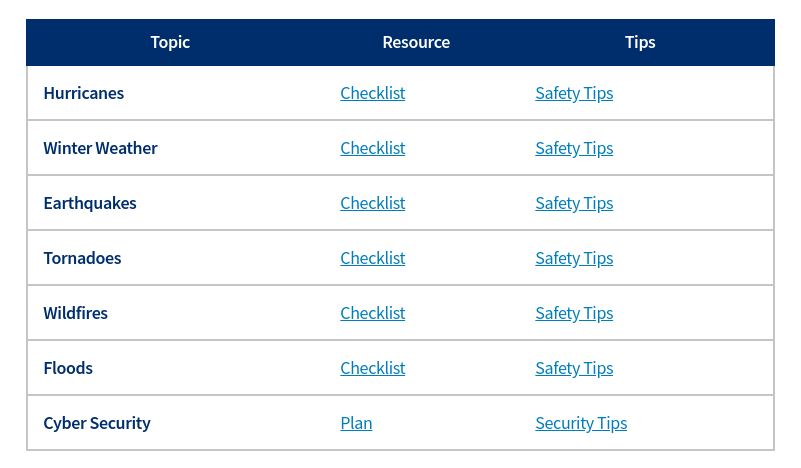
While, again, there is nothing specific to a pandemic, you can still use these as guidelines for how your business can respond. For example, the Flood Preparedness checklist has the following sections:
- Before the Flood
- During the Flood
- After the Flood
- Your People
Instead of Flood, you could substitute Restrictions. Currently in Texas, we do not have to “shelter in place” but that could be coming. What can you do now to prepare for that eventuality (Before the Restrictions)? What are you going to do when your state closes every “non-essential” business (During the Restrictions)? If you’re a restaurant, what are your plans for when you can reopen and all these stir-crazy customers flood your store (After the Restrictions)? Finally, what are you doing to make sure your employees are ready for each of these stages?
I have seen businesses take measures on their own. Local grocery chain H-E-B is restricting the number of customers who can enter their stores. I visited my little store here in my hometown, and the much larger store in McAllen and they are both doing this. This is a company thinking about customer and employee safety. They are also handing out alcohol wipes so you can wipe down your cart as you go through. I went through self-checkout, and the employee had just wiped down the station. They have a plan. I also stopped at a gas station on the way home and they had marked the floor with where you should stand in line and your number in line. Each marker 6 feet apart. The cashier had gloves on to handle the money.
Every store that has taken measures on their own is hopefully writing them down for the future, and adding things as they go, as this is the first pandemic to hit the U.S. with this severity probably since 1918. Also, we could practice some of these on a smaller scale every flu season (access to hand sanitizer, wipes, gloves for employees, etc.). Hopefully, we won’t have to deal with something on this level again, but who knows what disaster could strike next, and if you have plans for most, you can probably adapt them for novel situations.
Let me know what precautions your company is taking. Have you noticed any precautions that made you think, “everyone should do this”? Let me know in the comments below.

 Joe Robles